Manual pallet jacks, or transpaletas manuales, are essential tools for moving palletized goods.
Models like the Niuli and QVOLT offer capacities from 1T to 5T,
facilitating efficient material handling in diverse settings, from warehouses to retail spaces.
What is a Manual Pallet Jack?
A manual pallet jack (transpaleta manual) is a hand-powered tool used to lift and move pallets.
Unlike forklift trucks, it relies on human force and a hydraulic system.
Models like the Noblelift HPT20S and INELDEC QVOLT exemplify this, offering a cost-effective solution for short-distance pallet transport.
These jacks are crucial for loading, unloading, and moving materials within warehouses and retail environments.
Historical Development of Manual Pallet Jacks
The evolution of the manual pallet jack (transpaleta manual) began with early hand trucks.
The introduction of hydraulic systems significantly improved lifting capabilities.
Over time, manufacturers like Niuli and LiuGong refined designs, focusing on durability and ease of use.
Modern models, such as the QVOLT, incorporate features like weighing systems, enhancing efficiency in logistics and warehousing.
Types of Manual Pallet Jacks
Manual pallet jacks come in standard, mini, and weighing varieties.
The QVOLT is an example, while Niuli offers diverse options for varied load and space requirements.
Standard Manual Pallet Jacks
Standard manual pallet jacks, like many Niuli models, are the most common type, designed for general warehouse use. They efficiently move palletized loads utilizing a hydraulic lifting mechanism.
These jacks typically handle capacities between 1T and 5T, offering robust performance for diverse applications. They are a cost-effective solution for businesses needing reliable material handling.
Mini Manual Pallet Jacks
Mini manual pallet jacks are designed for confined spaces where standard models are impractical. These compact transpaletas manuales offer maneuverability in tight aisles and smaller work areas. While having lower weight capacities, they provide a practical solution for retail or limited-space applications, ensuring efficient handling of smaller loads.
Weighing Manual Pallet Jacks
Weighing manual pallet jacks, like the Noblelift HPT20S, integrate scales directly into the transpaleta manual. This provides on-the-spot weight verification, streamlining inventory control and shipping processes. Combining transport and weighing eliminates double handling, increasing efficiency and accuracy in warehouse operations.
Key Components of a Manual Pallet Jack
Transpaletas manuales feature key parts: the forklift, a hydraulic system for lifting, and a handle with a control lever for operation and maneuverability.
Forklift and Lifting Mechanism
The forklift component of a transpaleta manual consists of robust steel forks designed to securely engage pallet openings. The lifting mechanism, powered by the hydraulic system, raises these forks.
Noblelift’s HPT20S model exemplifies this, enabling smooth elevation of loads. Fork length and width vary based on application needs.
Hydraulic System
The hydraulic system within a transpaleta manual is crucial for lift. It utilizes fluid pressure to elevate the forks, requiring minimal operator effort. Regular inspection and appropriate transmission oil – like API GL-4 classified fluids – are vital for optimal performance and longevity, preventing common issues.
Handle and Control Lever
The handle and control lever of a transpaleta manual provide operator control. They manage pumping action for lifting and lowering loads. Ergonomic designs enhance usability, reducing operator fatigue. Precise lever operation ensures smooth, controlled movements during material handling, vital for safety and efficiency.
Operational Principles
Manual pallet jacks utilize a hydraulic system activated by the handle. Pumping the lever raises forks, while releasing it lowers them, enabling efficient load movement.
How the Hydraulic System Works
Manual pallet jacks employ a relatively simple hydraulic system. Pumping the control lever forces hydraulic oil into a cylinder, lifting the forks and the load.
Releasing the lever allows oil to flow back, lowering the forks. This system, often requiring API GL-4 classified oil, provides mechanical advantage for heavy lifting,
ensuring smooth and controlled pallet movement without external power sources.
Safe Operating Procedures
Manual pallet jack operation demands caution. Always inspect for damage before use. Ensure a clear path, avoiding uneven surfaces. Distribute the load evenly and never exceed the jack’s capacity (1T-5T).
Avoid sudden movements and maintain a firm grip on the handle. Proper training is crucial for safe and efficient operation.
Load Capacity and Weight Distribution
Manual pallet jacks, like the Niuli, range from 1T to 5T capacity. Even weight distribution is vital for stability; avoid unbalanced loads.
The load center (500mm) impacts capacity. Exceeding limits compromises safety and jack performance. Always verify the pallet’s weight before lifting.
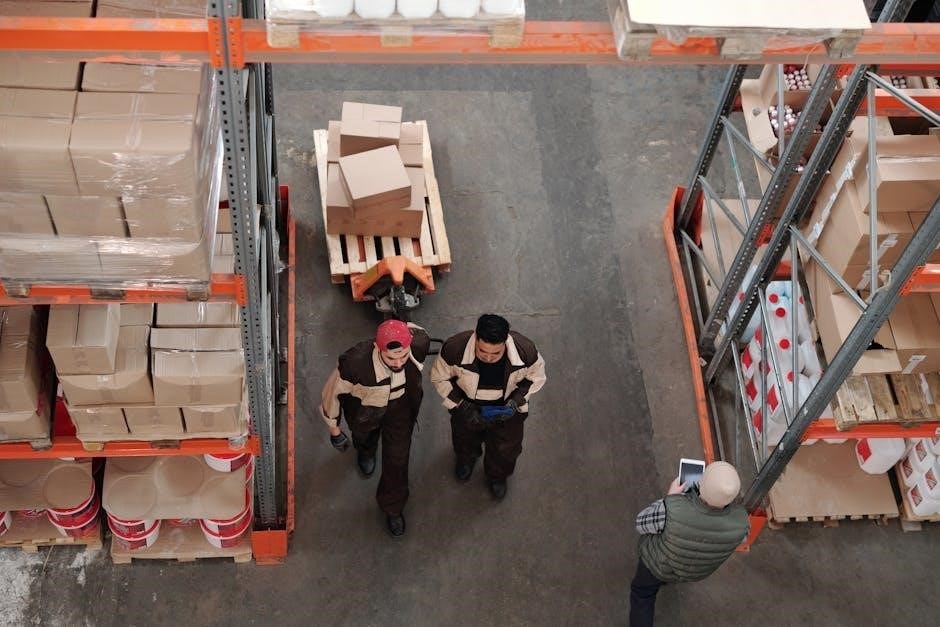
Applications Across Industries
Manual pallet jacks are widely used in warehousing, retail, and manufacturing.
The QVOLT and Noblelift HPT20S models efficiently move materials across diverse operational environments.
Warehousing and Logistics
Manual pallet jacks, like those from Niuli and Noblelift, are indispensable in warehousing for efficient pallet movement. They navigate tight aisles, loading docks, and storage areas effectively.
These tools streamline logistics, reducing labor costs and improving overall operational speed.
Models such as the HPT20S are crucial for quick and safe material handling.
Retail and Wholesale
Manual pallet jacks, including mini versions, are vital for retail and wholesale environments. They efficiently move merchandise from delivery trucks to sales floors or storage.
The QVOLT model exemplifies this, enabling easy maneuvering within confined spaces. These jacks support quick restocking and order fulfillment, boosting productivity and sales.
Manufacturing and Production
Manual pallet jacks, like those from LiuGong and Niuli, are crucial in manufacturing for moving raw materials and finished goods. Their robust design handles heavy loads (1T-5T), streamlining production workflows.
These jacks facilitate efficient transport between workstations, improving overall manufacturing efficiency and reducing downtime.
Maintenance and Safety
Manual pallet jacks require regular inspection and proper hydraulic oil (API GL-4) for optimal function.
Prioritize safety by addressing common issues promptly to prevent accidents and ensure longevity.
Regular Inspection Checklist
Prior to each use, inspect the transpaleta manual for damage. Check forks for bends or cracks, and verify smooth pump operation. Examine hydraulic fluid levels, looking for leaks.
Ensure wheels roll freely and the handle is secure. Regularly assess the overall structural integrity, addressing any concerns immediately for safe operation.
Hydraulic Oil Considerations
Utilize API GL-4 classified transmission oil within your transpaleta manual to ensure optimal performance. Consider synthetic oils for superior protection under heavy loads, like those handled by Noblelift models. Regularly check oil levels and condition, replacing as needed to prevent damage and maintain efficient hydraulic function.
Common Issues and Troubleshooting
Transpaleta manual issues often involve hydraulic leaks or pump failure. Check for worn seals and hoses. Difficulty lifting may indicate low or contaminated hydraulic oil – ensure API GL-4 compliance. Niuli and QVOLT models require regular inspection; address sticking wheels promptly for smooth operation.

Specifications and Load Capacities
Transpaleta manual specifications range from 1T to 5T load capacity, with varying fork lengths and widths. Noblelift’s HPT20S exemplifies these diverse options.
Understanding Load Capacity Ratings (1T ‒ 5T)
Manual pallet jack load capacities, denoted as 1T to 5T (tonnes), dictate the maximum weight safely handled. A 1T jack manages approximately 2,200 lbs, while 5T supports up to 11,000 lbs.
Niuli offers models across this spectrum. Selecting the correct capacity, considering load weight and distribution, is crucial for operational safety and efficiency.
Fork Length and Width Options
Manual pallet jack fork dimensions significantly impact usability. Longer forks (e.g., 45″ or 55″) accommodate wider pallet loads, enhancing stability. Fork width varies; standard widths suit most pallets. Noblelift’s HPT20S exemplifies adjustable options. Proper fork selection ensures secure load engagement and maneuverability within aisle constraints.
Overall Dimensions and Maneuverability
Manual pallet jack size dictates maneuverability in tight spaces. Compact mini transpaletas excel in confined areas, while standard models offer greater load capacity. Overall length and turning radius are crucial considerations. LiuGong designs prioritize ease of use, ensuring efficient navigation within warehouses and retail environments.

Choosing the Right Manual Pallet Jack
Selecting a transpaleta manual requires assessing load weight and aisle width. Noblelift’s HPT20S and INELDEC’s QVOLT represent diverse options, demanding careful comparison for optimal performance.
Factors to Consider (Load Weight, Aisle Width)
Crucial factors when choosing a transpaleta manual include maximum load weight and available aisle width. Niuli offers models spanning 1T-5T capacity. Narrower aisles necessitate shorter fork lengths, while heavier loads demand robust construction.
Consider maneuverability; a compact design, like a mini transpaleta, aids tight spaces.
Comparing Different Models (HPT20S, QVOLT)
The Noblelift HPT20S stands out with potential weighing system integration, enhancing inventory control. Conversely, the INELDEC QVOLT is a robust manual hydraulic transpaleta, ideal for general pallet movement. Both offer reliable performance, but HPT20S’s features cater to more advanced logistical needs.
Supplier Selection and Pricing
Sourcing transpaletas manuales requires careful supplier evaluation. Companies like Noblelift and LiuGong offer direct contact for pricing. Consider geographical distribution; Chinese manufacturers are prominent. Pricing varies based on capacity (1T-5T) and features, so detailed quotes are crucial for informed purchasing decisions.
Future Trends in Pallet Jack Technology
Transpaleta manual evolution includes integrated weighing systems, like the HPT20S, and ergonomic enhancements for improved operator comfort and efficiency in logistics.
Integration with Weighing Systems
Manual pallet jacks are increasingly incorporating integrated weighing capabilities, exemplified by models such as the Noblelift HPT20S. This integration streamlines inventory management, reducing the need for separate weighing processes.
Real-time weight data enhances accuracy, improves shipping logistics, and facilitates better control over product quantities, boosting overall operational efficiency.
Ergonomic Improvements
Manual pallet jack designs are evolving to prioritize operator comfort and safety. Manufacturers are focusing on features like cushioned handles and adjustable control levers to reduce strain.
Improved handle positioning and lighter materials minimize physical exertion during operation, enhancing productivity and decreasing the risk of repetitive stress injuries for workers.
Manual Pallet Jacks vs. Electric Pallet Jacks
Manual pallet jacks offer a lower initial cost compared to electric models. However, electric jacks provide greater efficiency and reduced operator fatigue for high-volume tasks.
Cost Comparison
Manual pallet jacks, such as the Niuli forklift, generally represent a significantly lower upfront investment than their electric counterparts. Basic manual models can range from a few hundred to around a thousand dollars.
Electric pallet jacks, offering automated operation, typically start around $3,000 and can exceed $10,000 depending on features and capacity.
Performance Comparison
Manual pallet jacks, like the Noblelift HPT20S, rely on operator strength and pumping action for lift and movement. Electric models provide effortless operation and faster travel speeds. While manual jacks excel in tight spaces, electric versions handle heavier loads and longer distances more efficiently.
Suitability for Different Environments
Manual pallet jacks are ideal for smaller warehouses, retail spaces, and loading docks with limited room. Mini manual pallet jacks suit confined areas. Electric models are better for large facilities, outdoor use, and frequent, long-distance transport of heavy pallets, offering superior performance.
Global Manufacturers and Suppliers
Niuli, Noblelift, and LiuGong are notable transpaleta manual manufacturers. These brands have a widespread geographical distribution, serving diverse global markets with their products.
Notable Brands (Niuli, Noblelift, LiuGong)
Niuli offers robust hydraulic manual pallet trucks, like the HPT20S, known for their durability and load capacity. Noblelift provides intelligent equipment, including weighing transpaletas manuales, enhancing operational efficiency. LiuGong, while also a MEWP provider, contributes to the manual pallet jack market, offering reliable solutions for material handling needs across various industries.
Geographical Distribution of Manufacturers
China dominates transpaleta manual manufacturing, with companies like LiuGong and Niuli based there. Noblelift also operates within China’s industrial landscape. While specific global distribution networks aren’t detailed, these manufacturers likely serve international markets, supplying pallet jacks worldwide, impacting logistics and warehousing globally.

Safety Regulations and Standards
OSHA guidelines and European Safety Standards dictate safe transpaleta manual operation. Adherence ensures worker protection during loading, transport, and unloading processes, minimizing risks.
OSHA Guidelines
OSHA emphasizes proper training for transpaleta manual operators, covering safe lifting techniques and load handling. Regular inspections are crucial, ensuring jacks are maintained in safe working condition.
Guidelines address load capacity limits, preventing overloads and potential instability;
Clear pathways and appropriate personal protective equipment (PPE) are also mandated for operator safety.
European Safety Standards
European safety standards for transpaleta manual prioritize ergonomic design and operational safety. These standards dictate stability testing, ensuring jacks handle loads securely.
Requirements cover marking with load capacities and clear operating instructions.
Regular risk assessments and adherence to EN standards are vital for compliance and worker protection.

Transpaleta Manual and Transmission Oils
Transmission oils, like API GL-4 classified fluids, are crucial for transpaleta manual hydraulic systems.
Synthetic options, such as Volvo’s 97307, offer superior protection and extended service intervals.
API GL-4 Classification
API GL-4 classification signifies transmission oils specifically designed for manual pallet jack hydraulic systems and gearboxes. These oils provide adequate lubrication and protection for components experiencing moderate to high loads. They are suitable for applications where hypoid gears aren’t subject to extreme pressures, ensuring smooth transpaleta manual operation and longevity.
Synthetic vs. Conventional Oils
Synthetic oils offer superior performance for transpaleta manual hydraulic systems, excelling in extreme temperatures and extending oil change intervals. Conventional oils are a cost-effective option for less demanding applications. Volvo-approved synthetic transmission fluids, like 97307, maximize protection and reduce maintenance costs for pallet jacks.